
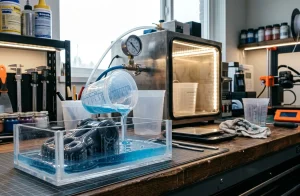
Silicon Mould Tools for 3D Printing: Complete Workflow
Silicon mould tools for 3D printing refer to the dedicated equipment, chemical release agents, degassing chambers, and …
3D Printing Materials encompasses the chemical formulations, polymer rheology, mechanical properties, and processing behaviors of thermoplastics, photocurable resins, composite matrixes, and soluble support media across all additive manufacturing processes.
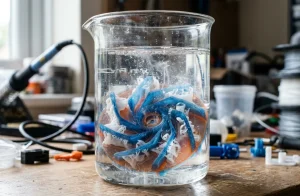
Chemical dissolution protocols for water-soluble Polyvinyl Alcohol (PVA) and limonene-soluble High Impact Polystyrene (HIPS) in complex geometries.
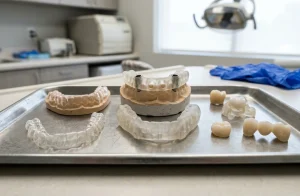
ISO 10993 cytotoxicity compliance, USP Class VI medical resins, and autoclave sterilization protocols for dental and clinical implants.
Sub-micron surface finishing through solvent vapor phase condensation, sealing internal porosity and increasing elongation at break.
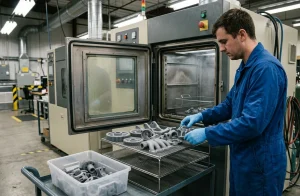
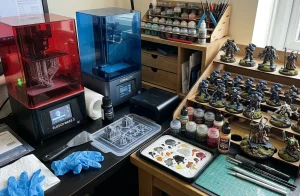
Hybrid additive manufacturing workflow creating master patterns for room-temperature vulcanizing (RTV) silicone tooling and polyurethane casting.
Material selection in additive manufacturing directly dictates part tensile strength, thermal resistance, chemical durability, and dimensional stability. Thermoplastics used in FDM/FFF are fundamentally bifurcated into amorphous and semi-crystalline polymers. Amorphous polymers (such as PLA, ABS, and Polycarbonate) exhibit a gradual glass transition (Tg) without sharp melting points, resulting in predictable shrinkage rates (typically 0.4% to 0.7%) and minimal thermal warping during layer-to-layer cooling. Conversely, semi-crystalline polymers (such as PA/Nylon, PEEK, and Polypropylene) undergo molecular chain alignment during crystallization, necessitating precise thermal chamber control to prevent violent isotropic shrinkage exceeding 2.5%.
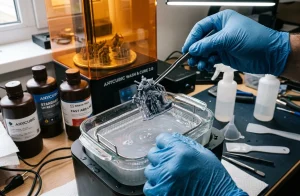
Photopolymer resins operate via free-radical or cationic photo-initiated polymerization. When exposed to 405nm ultraviolet radiation, liquid acrylate or epoxy monomer chains cross-link into rigid thermoset networks. Unlike thermoplastics, cured photopolymers cannot be remelted, offering exceptional isotropic dimensional accuracy and chemical resistance. However, their susceptibility to UV degradation and hygroscopic embrittlement requires secondary post-cure cross-linking and surface sealants for long-term engineering applications.
Composite filaments incorporate micro-chopped carbon fibers, glass fibers, or ceramic powders into thermoplastic base matrixes (e.g., PA-CF, PETG-CF). Fiber reinforcement increases flexural modulus and tensile stiffness while dramatically suppressing thermal warping, though requiring wear-resistant hardened steel or ruby nozzles to withstand severe abrasive bore erosion.
| Material Family | Glass Transition (Tg) | Heat Deflection (HDT @ 0.45MPa) | Key Mechanical Attribute |
|---|---|---|---|
| PLA (Polylactic Acid) | 55°C – 60°C | 52°C | High tensile modulus (3.5 GPa) & effortless printability |
| PETG (Glycol-Modified) | 75°C – 80°C | 70°C | Superior chemical resistance & interlayer impact toughness |
| ABS / ASA Co-polymer | 100°C – 105°C | 95°C | High impact strength, ductility & UV weatherability (ASA) |
| Nylon PA12 / PA6 | 50°C – 65°C | 90°C – 160°C | Exceptional fatigue resistance, low friction & high flexibility |
| PEEK / PEKK (PAEK) | 143°C – 160°C | 250°C – 300°C | Continuous service above 240°C, flame-retardant (UL94 V-0) |
Layer delamination occurs when rapid thermal contraction creates tensile stresses along the Z-axis that exceed the inter-layer weld strength. An enclosed chamber heated to 60°C–90°C maintains the polymer near its glass transition point, allowing polymer chains to inter-diffuse across layer boundaries.
Hygroscopic filaments (Nylon, PETG, TPU, PVA) absorb atmospheric water vapor within hours. When fed into a 240°C nozzle, water instantly flashes into steam bubbles, causing violent popping, severe foaming, surface voids, and up to a 40% reduction in tensile strength.
Standard FDM prints harbor microscopic crevices between layers where bacteria proliferate. True medical sterilization requires certified biocompatible resins or autoclave-resistant filaments (like PEEK or Medical Polypropylene) followed by validated ethylene oxide (EtO) or gamma irradiation.


![What’s the Best 3D Printer Filament? [Top Picks for 2025]](https://3d-p.eu/wp-content/uploads/2025/04/759-whats-the-best-3d-printer-filament-top-picks-for-2025.jpg "What’s the Best 3D Printer Filament? [Top Picks for 2025]")