Best Resin 3D Printers for Warhammer Miniatures | 3D-P.eu
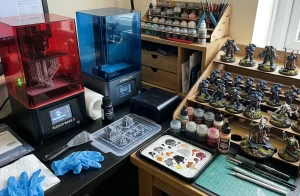
The best resin 3D printers for Warhammer miniatures feature high-resolution monochrome LCD screens (8K to 14K) with …
Resins & Photopolymers details the formulation, ultraviolet curing kinetics, handling safety, and material properties of liquid photopolymer resins used in SLA, MSLA, and DLP additive manufacturing systems.
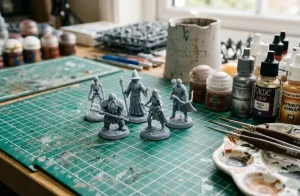
Hardware and resin pairing guide detailing 8K/12K LCD screens, light uniformity metrics, and anti-aliasing for microscopic scale models.
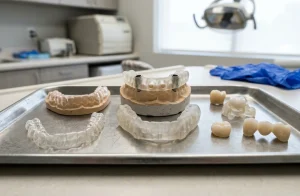
Engineering standards for surgical drill guides, dental aligners, splints, and skin-contact medical resins meeting ISO 10993.
Calibration of normal layer exposure, transition layers, light-off delay, and lift speeds to eliminate delamination in miniature printing.
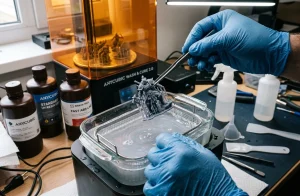
Complete chemical post-processing SOP covering two-stage IPA washing, ultrasonic cleaning hazards, and secondary UV cross-linking.
Photopolymer 3D printing relies on ultraviolet (UV) light energy (typically 385nm to 405nm) to trigger free-radical polymerization in a liquid resin vat. Uncured resin consists of liquid oligomers (providing primary mechanical backbone), reactive monomers (controlling viscosity and dilution), and photoinitiators. When struck by UV photons, photoinitiators decompose into reactive radicals that chain-link monomer-oligomer double bonds into a dense three-dimensional polymeric thermoset matrix.
Calibrating resin exposure times is a balancing act governed by the Beer-Lambert law of light absorption. Under-exposure leaves unreacted monomer bonds, resulting in weak support tips, sagging overhangs, and print failures on the FEP film. Over-exposure causes light bleed (parasitic curing) through adjacent pixels, filling in fine negative details, engraving recesses, and pinholes. Utilizing exposure validation matrices (like the Cones of Calibration or XP2 Validation Matrix) ensures dimensional accuracy within 15 microns.
Occupational hygiene and safety are non-negotiable when operating resin platforms. Liquid photopolymers are classified as skin sensitizers and toxic to aquatic organisms (H317, H411). Operators must wear heavy-duty nitrile gloves (latex dissolves under acrylate contact), safety glasses, and operate in dedicated ventilated enclosures with active carbon adsorption filtration to capture volatile organic compounds (VOCs).
| Resin Category | Tensile Modulus | Elongation at Break | Best Application |
|---|---|---|---|
| Standard Monomer Resin | 2.0 – 2.8 GPa | 4% – 8% (Brittle) | Visual display models, tabletop gaming miniatures |
| ABS-Like / Tough Resin | 1.5 – 2.2 GPa | 15% – 30% (Ductile) | Functional prototypes, snap-fit casings, rugged enclosures |
| High-Temperature Resin | 3.0 – 3.8 GPa | 2% – 5% | Heat deflection up to 220°C, wind tunnel testing, autoclave |
| Castable Wax Resin | 0.8 – 1.4 GPa | N/A (Zero Ash Burnout) | Direct investment casting for gold/silver jewelry and dental crowns |
| Biocompatible Dental Class IIa | 2.2 – 3.0 GPa | 10% – 15% | Long-term intraoral dental splints, surgical guides, aligners |
Liquid uncured resin clings to the surface of the green print. If exposed to UV light before thorough washing, this raw resin cures into a glossy, sticky layer that destroys sharp detail and leaves tacky residue. A two-stage IPA bath completely strips surface monomer residue.
Delayed cracking is almost always caused by trapped uncured resin inside hollow models without adequate drain holes, or severe over-curing under concentrated UV light that creates internal shrinkage stress fractures across thick walls.
Yes, once fully cured by UV light into an inert, hard plastic, photopolymer resin is non-hazardous solid waste. However, liquid uncured resin and contaminated IPA wash water are hazardous chemical waste and must never be poured down municipal drains.