
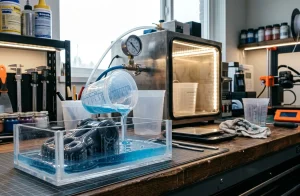
Silicon Mould Tools for 3D Printing: Complete Workflow
Silicon mould tools for 3D printing refer to the dedicated equipment, chemical release agents, degassing chambers, and …
Post-Processing Materials details chemical smoothing solvents, abrasive blasting media, surface primers, and epoxy sealants used to transform raw 3D printed components into production-grade parts with superior surface finishes and sealed internal structures.
Industrial automated chemical vapor smoothing protocols utilizing solvent vapor condensation to seal surface porosity and eliminate layer lines.
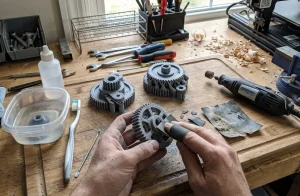
Hands-on techniques for progressive grit wet sanding, filler primers, plastic adhesion promoters, and automotive clear-coat sealing.
Master pattern surface finishing and degasification requirements for silicone mold fabrication and short-run urethane casting.
Surface preparation checklist covering degreasing, sandable primer application, acrylic airbrushing, and enamel durability topcoats.
Raw 3D printed parts invariably exhibit microscopic surface roughness (Ra values typically between 8 and 25 µm for FDM, and 1.5 to 5 µm for SLA) along with visible layer lines and support contact scars. Surface post-processing bridges the aesthetic and functional gap between rapid prototypes and injection-molded production parts. Techniques are broadly categorized into subtractive abrasive finishing (wet sanding, centrifugal tumbling, dry ice/bead blasting) and chemical phase-change smoothing.
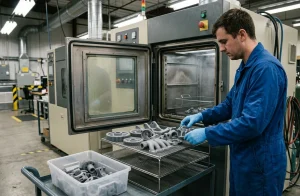
Chemical vapor smoothing exploits solvent-polymer solubility parameters. For ABS and ASA components, acetone vapor selectively dissolves the outermost polymer chains, allowing surface tension to draw microscopic ridges flat into a glossy, mirror-like finish within minutes while simultaneously sealing porous voids. For engineering nylon (PA11/PA12) and elastomeric TPU parts, automated industrial vapor smoothing chambers utilize controlled halogenated or ester solvent vapors under negative pressure, producing watertight, skin-safe surfaces without dimensional loss.
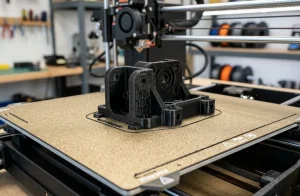
Painting 3D printed thermoplastics requires specialized chemistry due to low surface energy. Directly applied aerosol paints peel easily from untreated PLA, PETG, or polypropylene. Applying an automotive sandable high-build primer creates an anchor layer that fills micro-staircasing while providing mechanical keying for polyurethane, acrylic, or enamel topcoats.
| Post-Processing Method | Compatible Polymers | Surface Finish (Ra) | Key Technical Benefit |
|---|---|---|---|
| Acetone Vapor Smoothing | ABS, ASA only | Ra < 0.5 µm (Mirror Gloss) | Seals micro-porosity, improves elongation, zero manual labor |
| Automated Industrial Vapor | PA11, PA12, TPU, Polypropylene | Ra < 1.0 µm (Satin Injection-Look) | Certified skin-safe, sealed against bacterial absorption |
| Vibratory Tumbling (Media) | PLA, PETG, Nylon, Resin, Metals | Ra 1.5 – 3.0 µm (Matte Uniform) | Automated batch deburring & support scar removal |
| High-Build Sandable Primer | All FDM / SLA Thermoplastics | Ra < 0.2 µm (Show-Car Finish) | Fills layer steps prior to professional automotive painting |
| Epoxy Resin Coating | All porous additive parts | Ra < 0.4 µm (Glass Smooth) | Hermetically seals pressure vessels & food-safe contact surfaces |
No. Acetone does not dissolve PLA. Attempting to acetone smooth PLA will only soften or discolor the part without smoothing layer lines. PLA can be smoothed using ethyl acetate, tetrahydrofuran (THF), or dedicated epoxy resin surface coatings like XTC-3D.
Thermoplastics have low thermal conductivity and low melting points. Dry sanding creates friction heat that quickly gums up sandpaper and tears the plastic surface. Wet sanding with water lubricates the cut, washes away abraded plastic slurry, and yields a substantially smoother surface.
When properly calibrated, industrial vapor smoothing only affects a surface depth of 10 to 30 microns, leaving internal core geometries unchanged. However, uncontrolled manual acetone smoothing can melt thin walls, soften fine lettering, and round off sharp 90-degree corners.

![Do You Need to Wash 3D Printed Models? [Tips]](https://3d-p.eu/wp-content/uploads/2025/04/2344-do-you-need-to-wash-3d-printed-models-tips.jpg "Do You Need to Wash 3D Printed Models? [Tips]")


![Can You Use Acrylic Paint on 3D Printed Objects? [Guide]](https://3d-p.eu/wp-content/uploads/2025/04/512-can-you-use-acrylic-paint-on-3d-printed-objects-guide.jpg "Can You Use Acrylic Paint on 3D Printed Objects? [Guide]")