✨ This article was AI edited. Editorial responsibility: 3D-P.eu.
Produced with AI. This article was artificially generated. Editorial responsibility: 3D-P.eu.
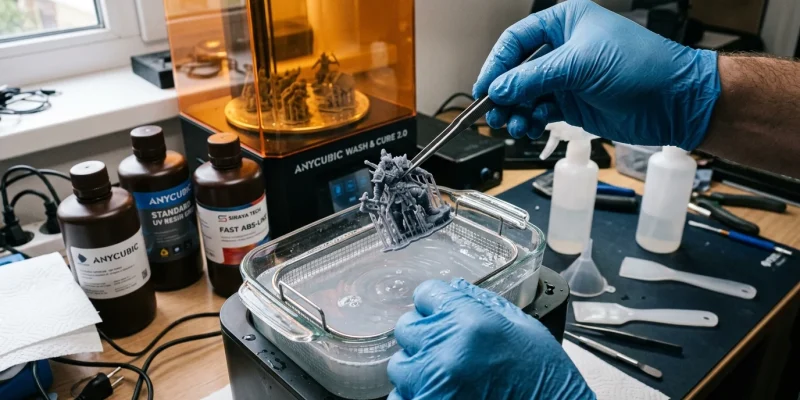
Resin (SLA/DLP/MSLA) 3D printing delivers unrivaled feature resolution, sharp corner definition, and smooth surface finishes. However, unlike filament prints that emerge solid and dry, resin prints leave the vat coated in a toxic, sticky layer of uncured liquid monomer. Proper cleaning is not an optional aesthetic step—it is a mandatory biochemical protocol that dictates the mechanical strength, safety, and dimensional fidelity of the final part.
Essential Safety Protocols for Handling Resin & Solvents
Liquid photopolymer resins contain hazardous acrylate and methacrylate monomers, photoinitiators, and chemical plasticizers. Repeated skin contact causes cumulative allergic contact dermatitis. Prior to commencing any cleaning operations, strictly ensure:
- Nitrile Gloves: Always wear heavy-duty nitrile gloves. Latex gloves are porous to photopolymer resins and degrade rapidly in Isopropyl Alcohol.
- Eye Protection: Chemical splash goggles prevent hazardous solvent splatters during wash agitation.
- Organic Vapor Respiratory Protection: Work in a well-ventilated space or chemical fume enclosure, or wear a respirator equipped with A1/A2 organic vapor cartridges.
- Zero Drain Disposal: Never pour resin-contaminated solvent down household drains or municipal sewers. Uncured resin is toxic to aquatic life.
Comparison of Resin Cleaning Solvents
Selecting the optimal washing solvent depends on resin chemistry, workshop ventilation, and safety requirements:
| Solvent | Solvency Power | Flash Point & Safety | Key Workshop Trade-off |
|---|---|---|---|
| 99% Isopropyl Alcohol (IPA) | Very High | 12°C (Highly Flammable) | Industry standard; fast evaporation; strong fumes |
| TPM (Tripropylene Glycol Monomethyl Ether) | High | 121°C (Non-Flammable) | Safer for enclosed spaces; leaves oily film requiring water rinse |
| Bio-Based Resin Detergents (e.g. Mean Green) | Moderate | Non-Flammable | Requires ultrasonic bath agitation; longer wash times |
| Warm Tap Water | Low (Water-Washable Resins Only) | Non-Flammable | Convenient; wash water remains hazardous chemical waste |
The Two-Stage “Dirty & Clean” Wash Protocol
To maximize solvent lifespan and eliminate sticky residue, professional additive labs utilize a two-stage wash cycle:
- Stage 1: Primary “Dirty” Bath (3–5 minutes): Submerge the fresh print in a pre-wash container. The agitated dirty solvent dissolves approximately 80–90% of excess liquid resin. Use a soft horsehair brush to dislodge resin trapped in intricate crevices.
- Stage 2: Secondary “Clean” Bath (3–5 minutes): Transfer the part into a secondary bath containing pristine 99% IPA. This strips away microscopic monomer traces without redepositing dissolved resin back onto the surface.
- Complete Evaporative Drying (15–30 minutes): Place the washed part on lint-free paper towels under gentle fan airflow. Never UV cure a wet print, as trapped solvent causes permanent white chalky scaling and micro-fracturing.
How to Recycle and Dispose of Contaminated IPA
Over time, cleaning solvent saturates with dissolved resin and turns cloudy. Instead of discarding it:
- Sunlight Curing & Settling: Pour used IPA into a transparent HDPE jug and place it in direct sunlight for 24–48 hours. The UV rays polymerize dissolved monomers, causing solid plastic sludge to settle at the bottom.
- Filtration: Filter the clear supernatant solvent through a 190-micron paint strainer into your “dirty bath” container for reuse.
- Solid Disposal: Once completely hardened and dry, the polymerized resin sediment is inert and can be safely discarded in standard household waste.
Frequently Asked Questions
Why do my resin prints have white powdery spots after curing?
White chalky residue occurs when parts are post-cured while still damp with Isopropyl Alcohol or when the IPA wash bath is overly saturated with dissolved resin. Ensure prints are 100% dry and your final wash bath is clean before UV curing.
Can I use an ultrasonic cleaner with Isopropyl Alcohol?
Never put pure Isopropyl Alcohol directly inside an ultrasonic cleaner basin—the cavitation transducer produces localized heating that can ignite flammable alcohol vapors. Instead, fill the cleaner basin with water, place the IPA and print inside a sealed ziplock bag or glass jar, and float the container in the water bath.
Is water from water-washable resin safe to pour down the sink?
No. Water-washable resin contains the same toxic, unpolymerized photoinitiators and monomers as standard resins. Wash water must be collected in containers, cured in the sun until particles precipitate out, and properly disposed of as chemical waste.
Get our latest guides, news, and insights highlighted in your Google Search & AI Overviews.