
✨ This article was AI edited. Editorial responsibility: 3D-P.eu.
Produced with AI. This article was artificially generated. Editorial responsibility: 3D-P.eu.
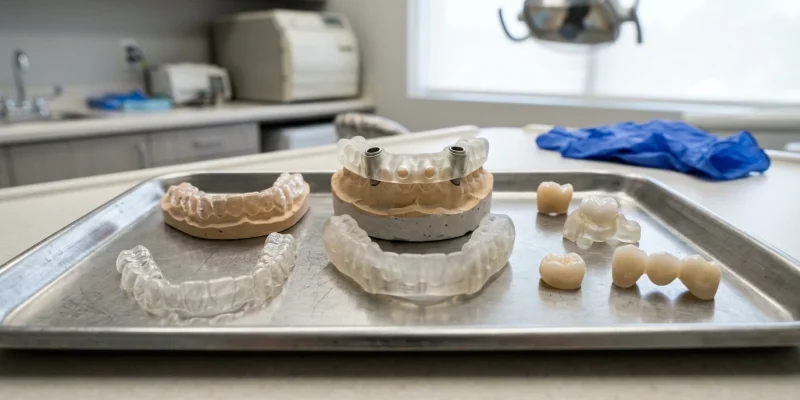
Additive manufacturing in healthcare and dentistry requires far more than dimensional accuracy: materials that come into contact with living tissue must undergo rigorous cytotoxicity, sensitization, and systemic toxicity testing. From custom clear dental aligners and autoclave-sterilizable surgical drill guides to patient-specific titanium cranial implants, biocompatible additive polymers are transforming clinical outcomes across modern medicine.
Biocompatibility Classification & Regulatory Standards
Biocompatible materials are categorized based on contact duration and biological tissue interaction:
| Biocompatibility Tier | Relevant Regulatory Standard | Primary Materials | Clinical Applications |
|---|---|---|---|
| Class I: Skin Contact | ISO 10993-5 (Cytotoxicity) & ISO 10993-10 (Irritation) | Medical TPU, Biocompatible PLA, Skin-safe Photopolymers | Orthopedic prosthetic sockets, wearable sensor housings, rehabilitation braces |
| Class IIa: Mucosal / Short-Term (<30 Days) | ISO 10993 / CE Medical Device Regulation (MDR) | Dental Surgical Guide Resin, Splint/Nightguard Resins | Implant surgical drill templates, orthodontic aligners, intraoral impression trays |
| Class IIb: Long-Term Oral (>30 Days) | ISO 10993 / FDA 510(k) Clearance | Ceramic-infused Hybrid Dental Resins, PEEK | Permanent dental crowns, bridges, denture bases, artificial teeth |
| Class III: Permanent Implants | ISO 10993 USP Class VI / ASTM F136 / ASTM F3001 | Medical Grade Titanium (Ti6Al4V ELI), Medical PEEK | Spinal fusion cages, porous trabecular hip stems, cranial bone repair plates |
Strict Post-Processing Protocols for Medical Resins
Unlike cosmetic prints where incomplete curing merely affects rigidity, improperly cured biocompatible resin leaves toxic free monomer molecules that cause tissue necrosis and mucosal ulceration. To achieve certified biocompatibility:
- Two-Stage Pure IPA Wash: Submerge in fresh >97% isopropyl alcohol using automated agitation (e.g. Formlabs Form Wash) for precisely 10 minutes. Solvent baths must be monitored with hydrometers to ensure resin concentration in alcohol remains under 2%.
- Thorough Compressed Air Dehydration: Blow dry all crevices with oil-free medical-grade compressed air and allow 30 minutes of complete ambient drying.
- Controlled Temperature UV Post-Curing: Cure inside a calibrated chamber (e.g., 405nm light at 60°C for 30 minutes). Heat accelerates polymerization kinetics, driving monomer conversion to >99.9%.
- Autoclave Sterilization (When Required): Surgical guides must endure steam autoclaving at 134°C (273°F) for 5 minutes without thermal geometric distortion.
Market Trends & Material Innovations in Additive Healthcare
- Direct 3D Printed Aligners: Eliminating thermoformed plastic sheets by printing shape-memory polymer aligners directly with sub-20-micron layer resolution.
- Bioactive Ceramic Scaffolds: Printing porous hydroxyapatite and tricalcium phosphate structures that resorb naturally into the human body as bone regenerates.
- Implantable High-Performance PEEK: Slicing medical-grade PEEK on high-temperature FDM platforms to replace metal plates with radiolucent, bone-modulus-matched spinal implants.
Frequently Asked Questions
Can standard hobby resin be made biocompatible with extra curing?
No. Standard hobby resins contain photoinitiators, heavy metal pigments, and toxic reactive diluents that are fundamentally cytotoxic. Biocompatible resins use medical-grade, non-toxic chemical formulations certified under ISO 10993.
What makes Titanium 3D printing superior for bone implants?
Metal 3D printing (DMLS) can generate porous trabecular lattice structures with 65% porosity. This mimics natural human cancellous bone, encouraging rapid cellular osseointegration that prevents implant loosening.
How do dental clinics validate biocompatible print batches?
Clinics maintain digital batch logs tracking resin lot numbers, expiration dates, wash solvent purity, UV chamber temperature profiles, and visual inspection checklists for every surgical guide or dental appliance.
Get our latest guides, news, and insights highlighted in your Google Search & AI Overviews.


