✨ This article was AI edited. Editorial responsibility: 3D-P.eu.
Produced with AI. This article was artificially generated. Editorial responsibility: 3D-P.eu.
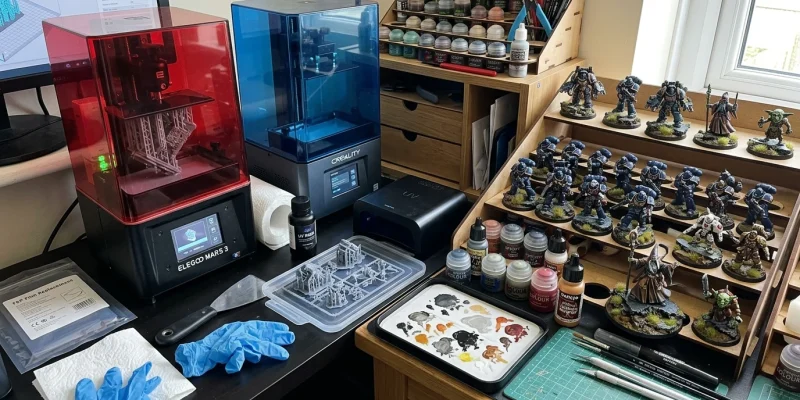
Printing tabletop wargaming infantry (28mm to 32mm scale) demands extreme optical precision: power armor rivets, chainmail links, facial stubble, and microscopic weapon engraving must resolve cleanly without voxel pixelation or layer banding. With the rapid evolution of monochrome LCD light engines, choosing the right resin printer involves evaluating pixel pitch, build volume, light uniformity, and automated leveling mechanics.
Top Desktop Resin Printers Compared for Miniature Printing
| Printer Model | Screen Resolution & XY Pitch | Build Volume (X x Y x Z) | Best Used For |
|---|---|---|---|
| Elegoo Mars 4 Ultra / 5 Ultra | 9K (18 x 18 µm pixel pitch) | 153 x 77 x 165 mm | Peak infantry detail, squad batches, low footprint |
| Elegoo Saturn 3 / 4 Ultra | 12K (19 x 24 µm pixel pitch) | 218 x 122 x 220 mm | Full army batch printing, large centerpiece monsters, tanks |
| Anycubic Photon Mono M5s Pro | 14K (16.8 x 24.8 µm pixel pitch) | 223 x 126 x 200 mm | Leveling-free automation, resin temperature heating |
| Phrozen Sonic Mini 8K S | 8K (22 x 22 µm pixel pitch) | 165 x 72 x 170 mm | High-contrast optical light engine, competitive display miniatures |
Key Hardware Features for Tabletop Miniatures
1. XY Pixel Pitch (Sub-25 Micron Standard)
In resin printing, resolution is defined by the physical size of individual LCD pixels (XY pixel pitch). A printer with an 18-micron pixel pitch (such as the Mars 4 Ultra) renders skin folds, eyelashes, and weapon filigree without noticeable anti-aliasing blurring.
2. Dual Linear Rails and Ball-Screw Z-Axis
Z-axis wobble is the enemy of smooth surface finishes. As heavy miniature build plates lift and retract during layer peels, single-rail gantries flex, creating horizontal banding lines across armor plates. Opt for dual linear guide rails with reinforced aluminum frames to ensure absolute mechanical rigidity.
3. Vat Heating & Thermal Equilibrium
Resin viscosity increases dramatically below 20°C (68°F), causing severe layer delamination, failed supports, and surface pitting. Maintaining resin temperature between 25°C and 30°C (via an active vat heating collar or PTC chamber heater) ensures low viscosity and rapid polymer flow.
Essential Post-Processing Equipment for Miniature Makers
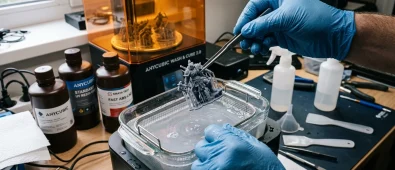
- Wash & Cure Station: An automated dual-station with magnetic impeller wash bucket and 405nm rotating UV turntable.
- ACF Release Film Vats: Advanced Composite Film (ACF) reduces release suction forces by 40%, allowing faster lift speeds without ripping delicate miniature hands or spears.
- Active Carbon VOC Air Scrubbers: Compact USB carbon filters placed inside the UV hood capture volatile organic compounds (VOCs) and resin odor.
Advanced Optical Calibration: Light Uniformity & Anti-Aliasing (AA)
Modern resin printers utilize Fresnel collimating lenses and COB (Chip-on-Board) light sources to achieve over 92% light uniformity across the entire LCD screen. Key calibration techniques include:
- Anti-Aliasing & Gray Level Tuning: Setting Anti-Aliasing to 4x with a Gray Level of 2 smooths out stepping on curved armor plates without softening razor-sharp sword edges.
- Tilt-Release Mechanics: Emerging printers (like the Saturn 4 Ultra) tilt the resin vat during peel moves, reducing separation forces by up to 50% and enabling sub-2-second layer cycles.
- Resin Drip Extraction: Angled build plate brackets allow uncured resin to drain back into the vat before washing, saving up to 15% in resin consumption per army batch.
Frequently Asked Questions
Is a Mars-size or Saturn-size printer better for Warhammer?
A Mars-sized printer (approx 6-7 inch screen) is ideal if you primarily print individual 28mm infantry squads and character models with maximum pixel density. A Saturn-sized printer (10 inch screen) is better if you plan to batch-print entire 2,000-point armies, large vehicles, and terrain pieces.
Does 12K resolution make a visible difference over 8K?
On small 7-inch screens, both 8K and 12K produce pixel sizes below 20 microns, which is beyond the limit of human visual acuity without a magnifying glass. On larger 10-inch screens, 12K resolution is beneficial because it maintains the sub-20-micron pixel pitch across a much larger build area.
What is the best release film for miniature printing?
ACF (Advanced Composite Film) and PFA (nFEP) provide the lowest peel adhesion forces, allowing successful printing of ultra-fine 0.20 mm support contact tips.
Get our latest guides, news, and insights highlighted in your Google Search & AI Overviews.