
✨ This article was AI edited. Editorial responsibility: 3D-P.eu.
Produced with AI. This article was artificially generated. Editorial responsibility: 3D-P.eu.
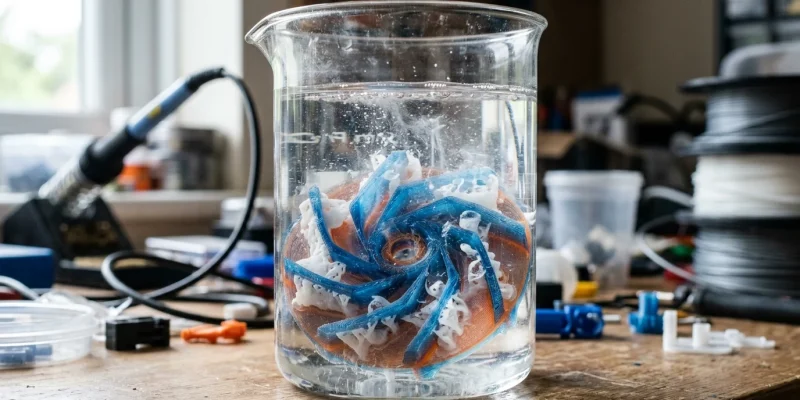
Manual breakaway supports often leave rough surface scarring, tear away delicate walls, or prove impossible to extract from enclosed internal cooling channels and print-in-place ball bearings. Dual-extrusion 3D printing using soluble filaments eliminates manual post-processing labor, enables impossible internal architectures, and guarantees flawless downward-facing surface finishes without compromising part integrity.
Soluble Support Material Matrix: PVA vs. BVOH vs. HIPS
| Support Polymer | Primary Build Material Pairing | Dissolution Solvent | Dissolution Time |
|---|---|---|---|
| PVA (Polyvinyl Alcohol) | PLA, Tough PLA, TPU | Plain Tap Water (Warm 35°C–45°C) | 4 to 12 hours (Faster with circulation) |
| BVOH (Butenediol Vinyl Alcohol) | PLA, PETG, ABS, ASA, PA (Nylon) | Plain Tap Water (Cold or Warm) | 1 to 3 hours (Ultra-fast dissolution) |
| HIPS (High Impact Polystyrene) | ABS, ASA (High-temp matching) | D-Limonene (Natural citrus solvent) | 8 to 24 hours |
| Aquasys 120 / 180 | PEEK, PEKK, Ultem, Carbon Fiber Nylon | Warm Water (60°C–80°C) | 2 to 6 hours |
How to Optimize Slicing for Soluble Interface Layers
Printing an entire support scaffold out of expensive soluble filament (which costs $60–$120 per kg) is economically wasteful. Advanced slicer configurations use Soluble Interface Mode:
- Set Support Body to Primary Material: Slice 95% of the support columns using cheap standard PLA or PETG from Extruder 1.
- Set Support Interface to Soluble Extruder: Direct the slicer to switch to Extruder 2 (PVA/BVOH) only for the final 2 to 3 interface layers directly touching the model.
- Zero Z-Distance Clearance: Because the interface material dissolves completely, set the vertical Top Contact Z Distance to
0.00 mm. This allows the model’s overhang to be ironed directly onto the support interface, resulting in a glass-smooth bottom ceiling. - Use a Purge / Prime Tower: Wipe the secondary nozzle inside an enclosed prime tower between tool changes to prevent cross-contamination and nozzle drool.
Best Practices for Storing & Handling Hygroscopic PVA/BVOH
Water-soluble filaments are extremely hygroscopic, absorbing ambient moisture from the air within hours. Moist PVA expands inside the hotend heat break, producing steam bubbles, severe stringing, and catastrophic nozzle clogs.
- Always print directly from an active filament dry box maintained at ≤15% relative humidity.
- Dehydrate saturated PVA spools inside a forced-air filament dryer at 50°C for 6 to 8 hours before printing.
- Purge nozzles thoroughly after soluble print jobs to prevent caramelized PVA polymers from hardening inside the heat zone.
Dual-Extrusion Hardware Calibration: XY Tool Offsets & Ooze Shields
Successful multi-material printing with soluble support requires micron-level hardware alignment between both hotends. Key calibration protocols include:
- Electronic Optical XY Offset Calibration: Slicers must know the exact physical distance between Nozzle 1 and Nozzle 2 down to +/-0.05 mm. Printing a vernier scale grid test allows measuring and entering precise G-code offset coordinates (
M218 T1 X[offset] Y[offset]). - Ooze Shields & Draft Blockers: Generating a thin sacrificial exterior perimeter shell around the model shields the part from stray filament oozing during secondary nozzle tool switches.
- Ultrasonic Cavitation Dissolution: Placing prints inside an ultrasonic cleaning bath (40 kHz) generates microscopic cavitation bubbles that physically dislodge dissolving PVA from enclosed channels up to 5x faster than passive soaking.
Frequently Asked Questions
How can I speed up PVA support dissolution?
Use warm water (approx 40°C to 45°C), an active magnetic stirrer or aquarium water pump for circulation, and clip off loose outer support chunks with flush cutters prior to submerging the part.
Can I dispose of dissolved PVA water down the sink drain?
Yes. PVA (Polyvinyl Alcohol) is fully biodegradable, non-toxic, and safe for standard municipal wastewater systems. Flush with warm tap water to prevent concentrated residue accumulation in P-traps.
What is the main difference between PVA and BVOH?
BVOH dissolves roughly 3x faster than PVA, adheres reliably to a wider range of polymers (including ABS, ASA, and Nylon), and offers significantly higher thermal stability in dual hotends.
Get our latest guides, news, and insights highlighted in your Google Search & AI Overviews.


![Can You Use Acrylic Paint on 3D Printed Objects? [Guide]](https://3d-p.eu/wp-content/uploads/2025/04/512-can-you-use-acrylic-paint-on-3d-printed-objects-guide.jpg "Can You Use Acrylic Paint on 3D Printed Objects? [Guide]")

