
✨ This article was AI edited. Editorial responsibility: 3D-P.eu.
Produced with AI. This article was artificially generated. Editorial responsibility: 3D-P.eu.
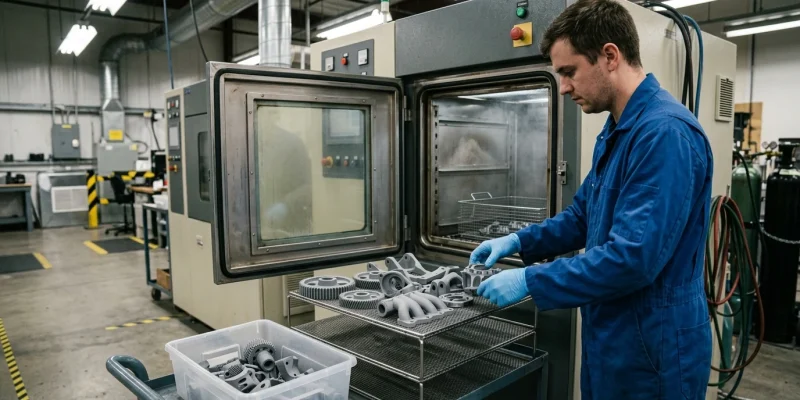
Powder bed fusion (SLS and MJF) and material extrusion (FDM) produce inherently porous, textured surface finishes with Ra values ranging from 4 to 15 microns. While abrasive tumbling and manual sanding are labor-intensive and round critical sharp edges, industrial chemical vapor smoothing transforms raw 3D prints into sealed, injection-mold quality parts in under 90 minutes. Understanding the operational thermodynamics, material compatibilities, and mechanical benefits of vapor smoothing is essential for volume additive production.
How Automated Vapor Smoothing Works (The 4-Stage Process)
| Process Phase | Physical Mechanism | Duration & Environmental Control |
|---|---|---|
| 1. Chamber Evacuation & Pre-Heating | Air is evacuated to create a deep vacuum while infrared heaters bring parts to uniform thermal equilibrium | 15 – 25 minutes (45°C – 65°C depending on polymer) |
| 2. Vapor Dosing & Surface Reflow | Proprietary solvent vapor is injected under controlled saturation, condensing onto microscopic peaks and melting surface asperities | 10 – 20 minutes (Sub-micron penetration depth) |
| 3. Closed-Loop Solvent Recovery | Vacuum condensers extract 100% of residual solvent vapor, recycling it into storage tanks with zero environmental exhaust | 20 – 30 minutes (Meets strict ATEX/OSHA limits) |
| 4. Thermal Annealing & Desorption | Chamber warms to drive out micro-trapped solvent molecules, stabilizing the sealed polymer matrix | 15 – 20 minutes |
4 Key Mechanical & Biological Advantages of Vapor Smoothing
1. Elimination of Surface Porosity (Liquid & Gas Tightness)
Raw SLS/MJF nylon absorbs moisture, oils, and gases like a sponge. Chemical vapor smoothing liquefies and seals the surface boundaries, creating completely non-porous, waterproof, and gas-impermeable components capable of withstanding pressurized fluid flow.
2. Significant Reduction in Surface Roughness (Ra < 1.0 µm)
Vapor smoothing reduces average surface roughness ($R_a$) from over $8.0 mu m$ down to below $0.8 mu m$. This delivers a glossy or semi-matte finish indistinguishable from injection-molded ABS or Polypropylene.
3. Improved Tensile Elongation & Fatigue Resistance
Microscopic surface cracks and voids act as stress concentrators under cyclic mechanical loading. By melting and sealing surface micro-notches, vapor smoothing increases part elongation-at-break by up to 25% and dramatically extends operational fatigue life.
4. Certified Biocompatibility & Cleanability
Sealing porous surface cavities prevents bacterial colonization and pathogen accumulation. Vapor-smoothed Nylon PA12 parts pass ISO 10993 cytotoxicity standards, making them suitable for wearable medical braces, prosthetic sockets, and food-contact devices.
PostPro 3D Chemistry: FA-3D vs Eco-Friendly Bio-Solvent Blends
Modern industrial vapor smoothing machines employ sophisticated eco-friendly chemistry formulations engineered for specific polymer families:
- Polyamide Solvent Formulations: Proprietary fluorinated alcohol blends engineered to dissolve outer nylon spherulite crystal boundaries without degrading internal bulk mechanical modulus.
- Elastomer & TPU Formulations: Optimized vapor saturation rates that preserve rubber rebound elasticity and Shore A durometer hardness while sealing surface crevices.
- Zero Hazardous Air Pollutants (HAPs): Advanced closed-loop condensing systems that operate well below European REACH and US EPA environmental exposure limits.
Comparative ROI: Manual Hand Finishing vs Automated Vapor Smoothing
In high-volume manufacturing environments, labor constitutes over 60% of total additive part cost when manual hand-sanding, priming, and buffing are required. Implementing automated vapor smoothing reduces manual post-processing labor hours by up to 85%, amortizing equipment capital expenditure within 6 to 12 months for active service bureaus.
Frequently Asked Questions
Which 3D printing materials can be vapor smoothed?
Automated vapor smoothing is compatible with Polyamides (PA11, PA12, PA6), TPU/TPE elastomers, Polypropylene (PP), ABS, ASA, PETG, and high-performance polymers like PEI (Ultem).
Does vapor smoothing alter part dimensions or tight tolerances?
Because vapor smoothing acts on a sub-micron boundary layer, dimensional change is typically under 0.4% (approx 20–40 microns), which is accounted for in CAD scaling for tight-tolerance mating features.
Is automated vapor smoothing safe for factory operators?
Yes. Unlike manual open solvent dipping, industrial systems (like AMT PostPro 3D) operate under sealed vacuum loops with automated solvent recovery, certified under ATEX and CE safety regulations.
Get our latest guides, news, and insights highlighted in your Google Search & AI Overviews.




 Guide | 3D-P.eu)