✨ This article was AI edited. Editorial responsibility: 3D-P.eu.
Produced with AI. This article was artificially generated. Editorial responsibility: 3D-P.eu.
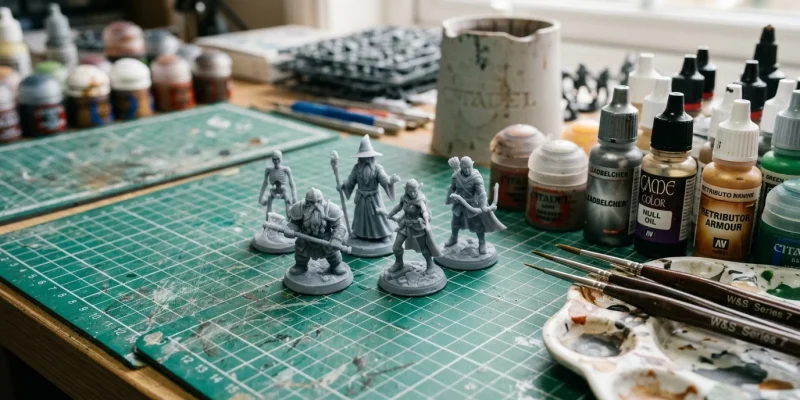
Tabletop wargaming miniatures—such as 28mm to 32mm heroic-scale Warhammer 40k and Age of Sigmar figures—feature intricate details: facial expressions, power armor panel lines, purity seals, and delicate weapons. While FDM printers struggle with stair-stepping on tiny curves, modern desktop resin printers can reproduce sub-micron details that rival or exceed commercial plastic kits. Achieving showroom results requires mastering orientation angles, custom light support placement, and proper post-cure rinsing.
Optimal Resin Slicing Settings for 28mm/32mm Miniatures
| Slicer Parameter | Recommended Value | Engineering Rationale |
|---|---|---|
| Layer Height | 0.025 mm – 0.035 mm (25–35 µm) | Eliminates visible layer steps under drybrushing and contrast washes |
| Normal Exposure Time | 1.4 s – 2.2 s (Calibrate via Cones of Calibration) | Prevents over-exposure blooming that fills in sharp recessed armor grooves |
| Bottom / Burn-In Exposure | 20 s – 30 s (4–6 layers) | Ensures tenacious adhesion of support raft to aluminum build plate |
| Lift Speed (Two-Stage Motion) | Slow (50 mm/min) then Fast (180 mm/min) | Minimizes sudden peel forces on delicate sword tips and spear shafts |
| Rest Time After Retract (Light-Off Delay) | 0.5 s – 1.0 s | Allows viscous resin to settle completely before UV exposure, eliminating blooming |
The 4 Pillars of Flawless Miniature Resin Printing
1. The 80/20 Durable Resin Blend Formula
Standard hobby photopolymer resin is notoriously brittle; dropping a miniature onto a tiled floor or gaming table often snaps weapons or limbs. The gold-standard community solution is mixing 80% high-detail ABS-like resin with 20% high-flex resin (such as Siraya Tech Tenacious). This creates resilient models that retain crisp facial micro-features while absorbing bending and impact shocks without breaking.
2. The 35°–45° Tilted Orientation Protocol
Never print a miniature standing flat parallel to the build plate. Orienting the model tilted backwards at 35° to 45° reduces the cross-sectional surface area of each individual layer, dramatically lowering FEP suction forces and directing all support contact points to the back and underside of the miniature where scars are easily hidden.
3. Graduated Support Strategy (Heavy, Medium, Light)
Use a hierarchical support architecture in your slicer (Lychee Slicer or Chitubox Pro):
- Heavy Anchors (0.80mm tips): Place 2 to 4 heavy supports at the lowest structural points (heels, base contact points) to anchor the model firmly against the build plate.
- Medium Supports (0.45mm tips): Support primary limbs, weapons, torso overhangs, and heavy armor segments.
- Light Micro-Supports (0.20mm–0.25mm tips): Support fingers, gun barrels, cloth capes, and sharp feather details to prevent delamination without leaving surface pits.
4. Warm Water Bath Support Removal Before Final Curing
Always remove supports after solvent washing but BEFORE final UV curing. Submerging the washed, uncured miniature into warm tap water (50°C) for 30 seconds softens the support tips. Supports will peel away effortlessly like velcro without tearing divots out of the model’s delicate surface.
Frequently Asked Questions
Can you print Warhammer miniatures on an FDM printer?
While possible with a 0.2 mm nozzle and 0.08 mm layer heights, FDM printing will always show visible layer stair-stepping on organic curves and faces. Resin MSLA printing is universally recommended for tabletop gaming miniatures.
How long should you cure resin miniatures in UV light?
Cure 28mm miniatures in a 405nm UV curing chamber for 2 to 4 minutes maximum. Over-curing for 10+ minutes causes the resin to become brittle and prone to yellowing.
What is the best way to clean uncured resin off minis?
Use a two-stage wash bath system with 99% Isopropyl Alcohol (IPA) or bio-ethanol. Wash for 3 minutes in the primary dirty bath, followed by 2 minutes in a clean ultrasonic or wash-and-cure agitation station.
Get our latest guides, news, and insights highlighted in your Google Search & AI Overviews.