
✨ This article was AI edited. Editorial responsibility: 3D-P.eu.
Produced with AI. This article was artificially generated. Editorial responsibility: 3D-P.eu.
3D print nozzle diameter effects govern the volumetric flow rate, layer adhesion mechanics, maximum print speed, and surface feature resolution of FDM/FFF 3D printers. Altering the nozzle orifice diameter directly scales the cross-sectional bead geometry of extruded thermoplastic, shifting the operational balance between ultra-fine geometric detail and structural component throughput.
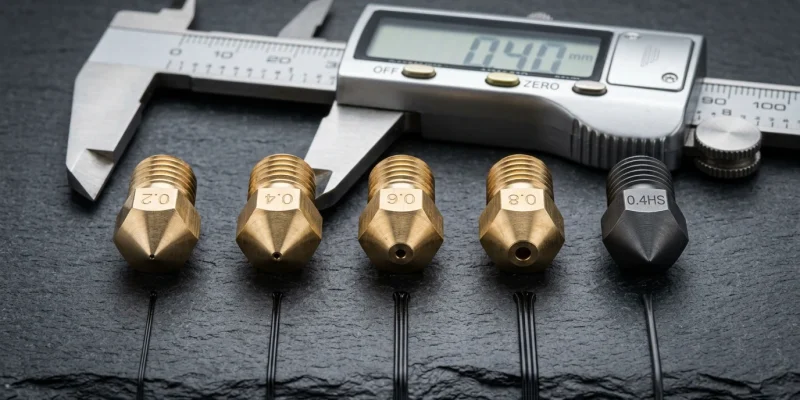
While the standard 0.4 mm brass nozzle has served as the default benchmark across desktop 3D printing for over a decade, selecting nozzle diameters ranging from 0.2 mm up to 1.0 mm or larger unlocks specialized performance characteristics. Understanding the fluid dynamics, back-pressure limitations, and slicing adjustments associated with nozzle size is vital for optimizing engineering parts and detailed aesthetic miniatures.
Comparative Physics: Nozzle Diameter Performance Matrix
Extrusion cross-sectional area scales quadratically relative to nozzle radius. Consequently, modest diameter increments yield substantial increases in volumetric output capability and interlayer bonding strength.
| Nozzle Diameter | Optimal Layer Heights | Typical Volumetric Rate | Print Time Factor | Primary Application Niche |
|---|---|---|---|---|
| 0.20 mm | 0.04 mm – 0.12 mm | 1.5 – 3.5 mm³/s | 3.5x slower than 0.4 mm | Tabletop miniatures, micro-gears, fine text embossing |
| 0.40 mm | 0.08 mm – 0.28 mm | 8.0 – 15.0 mm³/s | 1.0x (Standard baseline) | General consumer printing, balanced resolution & speed |
| 0.60 mm | 0.15 mm – 0.42 mm | 16.0 – 25.0 mm³/s | 0.55x (45% time savings) | Functional engineering prototypes, fiber-filled filaments |
| 0.80 mm | 0.20 mm – 0.56 mm | 22.0 – 32.0 mm³/s | 0.35x (65% time savings) | Large tooling fixtures, structural brackets, rugged enclosures |
| 1.00 mm+ | 0.30 mm – 0.75 mm | 30.0 – 45.0+ mm³/s | 0.22x (78% time savings) | Furniture, architectural models, rapid mold core printing |
Mechanical Strength and Interlayer Fusion Dynamics
A frequent misconception in additive manufacturing is that smaller layer heights automatically produce stronger parts. In reality, nozzle diameter exerts a significantly greater impact on tensile strength and Z-axis interlayer fracture resistance.
Wider extrusion lines deposited by 0.6 mm and 0.8 mm nozzles contain substantially greater thermal mass upon leaving the orifice tip. This residual heat partially remelts the previously deposited adjacent substrate layer, expanding polymer chain reptation across the weld interface. Empirical tensile testing demonstrates that test coupons printed with 0.8 mm nozzles exhibit up to 35% higher Z-axis tensile break resistance than identical geometries printed with 0.4 mm nozzles under standard cooling parameters.
Volumetric Flow Limits and Hotend Bottlenecks
When upgrading to larger nozzle diameters (0.6 mm and above), users frequently encounter unexpected underextrusion. This failure is rarely caused by the nozzle itself, but rather by exceeding the Maximum Volumetric Flow Rate (MVFR) of the heating block assembly.
The volumetric flow formula is expressed as:
Volumetric Flow (mm³/s) = Layer Height (mm) × Extrusion Line Width (mm) × Print Speed (mm/s)For example, running a 0.8 mm nozzle at a 0.4 mm layer height and 0.9 mm line width at 80 mm/s requires:
0.4 × 0.9 × 80 = 28.8 mm³/sStandard V6 or Creality hotends cannot melt more than 12–15 mm³/s of PLA before thermal decay causes extruder clicking. High-flow hotends (such as Volcano, Rapido, or Bambu Lab high-flow cores) with prolonged melt zones are required to support continuous extrusion above 25 mm³/s.
Abrasive & Composite Filament Compatibility
Nozzle diameter is also a critical factor when processing filled composite materials, including carbon fiber (CF-PETG, CF-Nylon) and glass fiber blends:
- 0.4 mm Nozzles: High risk of particulate clumping. Milled carbon fibers averaging 100–150 microns in length frequently bridge across 400-micron orifices, causing sudden filament jams.
- 0.6 mm Nozzles (Recommended Standard): The 600-micron bore provides ample clearance for suspended fiber bundles, virtually eliminating composite clogging while preserving clean perimeter resolution.
- Material Hardness: Brass nozzles erode within 250 grams of composite throughput. Always swap to hardened tool steel, tungsten carbide, or diamond-tipped nozzles when using abrasive filaments.
Slicer Adjustments for Nozzle Swaps
After changing nozzle diameter in hardware, recalibrate these core slicer parameters:
- Extrusion Width: Set default extrusion line width between 110% and 125% of nozzle diameter (e.g., 0.48 mm for a 0.4 mm nozzle; 0.72 mm for a 0.6 mm nozzle) to promote flattened bead adhesion.
- Retraction Distance & Speed: Larger nozzles hold greater fluid mass in the melt pool. Increase retraction distance slightly (by 0.2–0.5 mm on direct drive) and enable coasting/wipe features to suppress stringing.
- Pressure Advance / Linear Advance: Recalibrate K-factor coefficients. Larger orifices generate lower back-pressure, requiring lower advance values to avoid perimeter bulging on corner decelerations.
Frequently Asked Questions
Can I print detailed tabletop miniatures with a 0.6 mm nozzle?
A 0.6 mm nozzle cannot match the fine horizontal resolution required for miniature facial features, fine hair, or tiny weapons below 0.5 mm in width. For high-fidelity miniatures, a 0.2 mm or 0.25 mm nozzle paired with 0.06 mm layer heights is strongly recommended.
Does a larger nozzle diameter reduce overall print time?
Yes, significantly. Moving from a 0.4 mm nozzle to a 0.6 mm nozzle typically reduces overall print duration by 30% to 45% because each perimeter pass deposits up to twice the cross-sectional bead volume, reducing the required total perimeter loops and infill lines.
Do I need to increase printing temperature when using a larger nozzle?
When running a larger nozzle at higher speeds, increasing hotend printing temperature by 5°C to 15°C is often necessary to overcome thermal lag and ensure the higher volume of filament passing through the melt block is fully plasticized.
Get our latest guides, news, and insights highlighted in your Google Search & AI Overviews.


