
✨ This article was AI edited. Editorial responsibility: 3D-P.eu.
Produced with AI. This article was artificially generated. Editorial responsibility: 3D-P.eu.
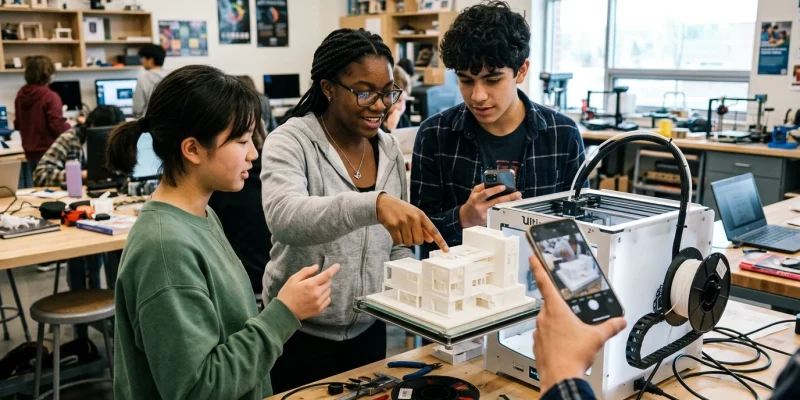
Introducing additive manufacturing into educational environments transforms theoretical STEM subjects into tangible, hands-on learning experiences. Rather than merely viewing 2D diagrams in textbooks, students can model molecular biological structures, test aerofoil wind tunnel models, and prototype functional robotics mechanisms. Successfully deploying 3D printing in schools requires structured curriculum scaffolding, safe machine fleets, and managed student slicing workflows.
Educational Additive Roadmap: K-12 to Higher Education
| Educational Level | Recommended Hardware & Materials | CAD Software & Tools | Core Learning Objectives |
|---|---|---|---|
| Elementary / Primary (Grades 1–5) | Fully enclosed safe FDM printers, non-heated beds, PLA filament | Tinkercad, 3D Slash | Spatial visualization, geometric shapes, introductory creative design |
| Middle School / Junior High (Grades 6–8) | Enclosed CoreXY FDM (Bambu Lab / Prusa), PLA & PETG | Autodesk Fusion 360 (Basics), Onshape | Parametric modeling, tolerance fits, bridge building physics contests |
| High School STEM & CTE (Grades 9–12) | Multi-material dual extrusion FDM, ventilated resin MSLA | SolidWorks, Fusion 360, OrcaSlicer | FIRST Robotics prototyping, SME CAM-F certification, DfAM principles |
| University & Research Engineering | Industrial SLS Nylon, Metal DMLS, PEEK high-temp FDM | ANSYS Additive Suite, Siemens NX, Materialise Magics | Finite element topology optimization, lattice biomechanics, alloy sintering |
5 Best Practices for Managing School Makerspace 3D Printers
1. Standardizing on Safe, Low-Emission Materials (PLA & PETG)
Classroom safety is paramount. Standardizing on bio-based PLA (Polylactic Acid) and PETG avoids toxic styrene ultrafine particle (UFP) emissions generated by ABS. For classrooms without external ducting, printers should be equipped with HEPA and activated carbon filtration.
2. Cloud Slicing & Print Queue Management
Managing SD cards across 30 students creates bottleneck chaos. Implementing cloud print management platforms (such as OctoPrint Fleet, Bambu Handy Classroom, or Polar Cloud) allows teachers to review student G-code, queue jobs automatically, and monitor live webcams.
3. “Design-Test-Redesign” Failure Normalization
3D printing teaches engineering resilience. Encouraging students to analyze print failures—such as layer delamination or improper support placement—develops critical root-cause diagnostic thinking that traditional multiple-choice exams cannot teach.
Pedagogical Integration: Integrating 3D Printing into Next-Gen STEM Standards
Aligning 3D printing activities with standardized engineering curricula ensures high academic ROI. Core pedagogical frameworks include:
- Iterative Design Thinking: Guiding students through the 5-stage Stanford d.school design framework (Empathize, Define, Ideate, Prototype, Test) using CAD models and rapid physical prototypes.
- Cross-Disciplinary Curriculum Links: In biology, printing accurate double-helix DNA molecular models; in history, replicating ancient archaeological artifacts from photogrammetry scans; in physics, testing cantilever truss deflection loads.
- Student Peer Review & Metrology: Teaching students to measure peer prints with digital vernier calipers against CAD dimension tolerances, instilling professional quality assurance discipline.
Frequently Asked Questions
How can schools fund 3D printing makerspaces?
Schools commonly fund makerspaces through government STEM educational grants (such as Perkins V in the US or Erasmus+ in Europe), local corporate engineering sponsorships, and PTA fundraisers.
Are resin 3D printers safe for high school classrooms?
Resin printers should only be used in dedicated, well-ventilated high school or university labs with mandatory personal protective equipment (PPE: nitrile gloves, safety goggles) and strict chemical waste disposal protocols.
What is the typical maintenance cost of school 3D printers?
Annual consumables and replacement parts (PLA spools, nozzles, PEI build plates, and PTFE tubes) typically average $150 to $250 per printer per academic year.
Get our latest guides, news, and insights highlighted in your Google Search & AI Overviews.


![What Is PLA Filament for 3D Printer? [Beginner’s Overview]](https://3d-p.eu/wp-content/uploads/2025/04/1341-what-is-pla-filament-for-3d-printer-beginners-overview-395x350.png "What Is PLA Filament for 3D Printer? [Beginner’s Overview]")


